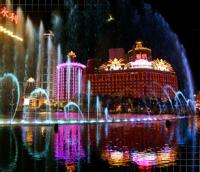
Babylon
Casino
Casa Real Casino
Casino Lisboa
Casino Crystal Palace
Casino de Presidente
Casino Macau Palace
Diamond Casino
Emperor Palace Casino
Fortuna Casino
Galaxy Rio Casino
Galaxy Starworld
Galaxy Waldo Hotel & Casino
Golden Dragon Casino
Grand Lisboa
Jai Alai Casino
Kam Pek Arabian's Night Casino
Kam Pek Casino de Louvre
Kingsway Hotel & Casino
Mandarin Oriental Casino
MGM Grand Macau
Mona Lisa Casino
Pharaoh's Palace Casino
Ponte 16
Sands Macao
The Legend Club
Wynn Macau
Taipa Island
Casino Taipa
Crown Macau
Galaxy Grand Waldo Casino
Grandview Casino/Macau Jockey Club Casino
Marina Casino
New Century Hotel & Casino/Greek Mythology Casino
Cotai Strip
City of Dreams (May, 2009)
Far East Consortium Complex (planned)
Four Seasons (2009)
Galaxy Mega Resort (2008)
Macau Studio City (2009)
The Venetian Macao
The
Macau Special Administrative Region, commonly known
as Macau or Macao , is one of the two special administrative
regions of the People's Republic of China, the other
being Hong Kong. Macau lies on the western side of
the Pearl River Delta, bordering Guangdong province
in the north and facing the South China Sea in the
east and south. The territory has thriving industries
such as textiles, electronics and toys, and a notable
tourist industry that boasts a wide range of hotels,
resorts, stadiums, restaurants and casinos.
Macau
was both the oldest and the last European colony in
China. Portuguese traders first settled in Macau in
the 16th century and subsequently administered the
region until the handover on December 20, 1999. The
Sino-Portuguese Joint Declaration and the Basic Law
of Macau stipulate that Macau operates with a high
degree of autonomy until at least 2049, fifty years
after the transfer. Under the policy of "one
country, two systems", the Central People's Government
is responsible for the territory's defence and foreign
affairs, while Macau maintains its own legal system,
police force, monetary system, customs policy, immigration
policy, and delegates to international organisations
and events.
Economy
of Macau
Macau's
economy is based largely on tourism, much of it geared
toward gambling. Other chief economic activities in
Macau are export-geared textile and garment manufacturing,
banking and other financial services. The clothing
industry has provided about three quarters of export
earnings, and the gaming, tourism and hospitality
industry is estimated to contribute more than 50%
of Macau's GDP, and 70% of Macau government revenue.
Macau
is a founding member of the WTO and has maintained
sound economic and trade relations with more than
120 countries and regions, with European Union and
Portuguese-speaking countries in particular; Macau
is also a member of the IMF.] World Bank classifies
Macau as a high income economy and the GDP per capita
of the region in 2006 was US$28,436. After the Handover
in 1999, there has been a rapid rise in the number
of mainland visitors due to China's easing of travel
restrictions. Together with the liberalization of
Macau's gaming industry in 2001 that induces significant
investment inflows, the average growth rate of the
economy between 2001 and 2006 is approximately 13.1%
annually.
In
a World Tourism Organization report of international
tourism statistics for 2006, Macau ranked 21st in
terms of tourist arrivals and 24th in terms of tourism
receipts. From 9.1 million visitors in 2000, arrivals
to Macau has grown to 18.7 million visitors in 2005
and 22 million visitors in 2006, with over 50% of
the arrivals coming from mainland China and another
30% from Hong Kong. Macau is expected to receive between
24 and 25 million visitors in 2007. Since the Handover,
Triad underworld violence, a deterring factor for
tourists, has virtually disappeared, to the benefit
of the tourism sector.
Starting
in 1962, the gambling industry had been operated under
a government-issued monopoly license by Stanley Ho's
Sociedade de Turismo e Diversões de Macau.
The monopoly ended in 2002, and several casino owners
from Las Vegas attempted to enter the market. With
the opening of the Sands Macau, the largest casino
in the world as measured by total number of table
games, in 2004 and Wynn Macau in 2006, gambling revenues
from Macau's casinos were for the first time greater
than those of Las Vegas Strip (each about $6 billion),
making Macau the highest-volume gambling centre in
the world. In 2007, Venetian Macau, the second largest
building in the world, opened its doors to the public,
followed by MGM Grand Macau. Numerous other hotel
casinos, including Galaxy Cotai Megaresort and Ponte
16, are also to be opened in near future.
In
2002, the Macau government ended the monopoly system
and six casino operating concessions and subconcessions
are granted to Sociedade de Turismo e Diversões
de Macau, Wynn Resorts, Las Vegas Sands, Galaxy Entertainment
Group, the partnership of MGM Mirage and Pansy Ho
Chiu-king, and the partnership of Melco and PBL. Today,
there are 16 casinos operated by the STDM, and they
are still crucial in the casino industry in Macau,
but in 2004, the opening of the Sands Macau ushered
in the new era.
Macau
is an offshore financial centre, a tax haven, and
a free port with no foreign exchange control regimes.
The offshore finance business is regulated and supervised
by the Monetary Authority of Macau, while the regulation
and supervision of the offshore non-finance business
is mainly controlled by the Macau Trade and Investment
Promotion Institute.In 2007, Moody's Investors Service
upgraded Macau's foreign and local currency government
issuer ratings to 'Aa3' from 'A1', citing its government's
solid finances as a large net creditor. The rating
agency also upgraded Macau's foreign currency bank
deposit ceiling to 'Aa3' from 'A1'.
As
prescribed by the Macau Basic Law, the government
follows the principle of keeping expenditure within
the limits of revenues in drawing up its budget, and
strive to achieve a fiscal balance, avoid deficits
and keep the budget commensurate with the growth rate
of its gross domestic product. All the financial revenues
of the Macau Special Administrative Region shall be
managed and controlled by the Region itself and shall
not be handed over to the Central People's Government.
The Central People's Government shall not levy any
taxes in the Macau Special Administrative Region.
(Credit:
Wikipedia).
Steve
Wynn is a man who not only makes the preposterous
possible, but also profitable.
The casino mogul and billionaire turned Las Vegas
from a strip of gambling dens into a global attraction,
helping to foster the Vegas ideal that it is a place
consenting adults can see and do just about anything
imaginable (plus, of course, gamble 24-hours a day).
If
that happens to include watching erupting volcanoes
and full-size pirate ship battles, then you can thank
Steve Wynn personally; he opened The Mirage, complete
with 50-feet-tall volcano, in 1989 and Treasure Island
four years later. The Bellagio followed in 1998 with
an indoor lake, dancing fountains, high-end boutiques
and an art gallery.
A keen art collector himself, Wynn owns one of only
39 Vermeer paintings and hangs it in his office.
Glitz,
opulence and priceless pieces of art, however, are
a long way from where Wynn began.
He
was 20 when he inherited the family bingo parlor business
in Maryland. But it was an encounter with Frank Sinatra
in Las Vegas that made him want to move to the desert.
Invited
to a private performance by the late singer, Wynn
recalls in his interview with Anjali Rao: "There
they were, eight feet away and full of it. There was
no comparable thing today about the glamour of that.
And at that moment, I was hooked. I wanted to be a
part of the Las Vegas scene."
He
finally moved there with wife Elaine in 1967, starting
out as an executive and part owner of the Frontier
Hotel.
It
was after some shrewd moves in the property market
-- including selling on a lot bought from billionaire
recluse Howard Hughes for $1 million profit -- that
seven years later he became part of the scene at the
age of 32 when be bought the Golden Nugget.
After
becoming the youngest casino owner in the U.S. and
pioneering the big and brash revival Las Vegas in
the late 1980's, he has been quick to change tack
with his latest generation of mega-casinos where it's
less about things to see and more about an experience
- natural light, of all things, is a prominent feature,
in the Wynn Las Vegas that opened in 2005.
It's still on a grand scale, like the Wynn Macau his
latest venture, which is set to be followed by two
more casinos in the former-Portuguese colony. Wynn
hopes his Asian flagship will tap into China and the
regions expanding middle classes.
"The
pent-up demand for the good life in China is extraordinary,"
he told Anjali Rao.